


The short answer: Port St. Lucie home insurance is two separate policies, flood and everything else. The City’s Class 5 rating cuts NFIP flood premiums 25% in high-risk zones and 10% elsewhere. Citizens wind policies need flood coverage from January 1, 2027. On the wind side, the roof, the wind mitigation report and the hurricane deductible set the price.
By Jeremy Beckham, REALTOR®, SFR | Last updated: November 20, 2026
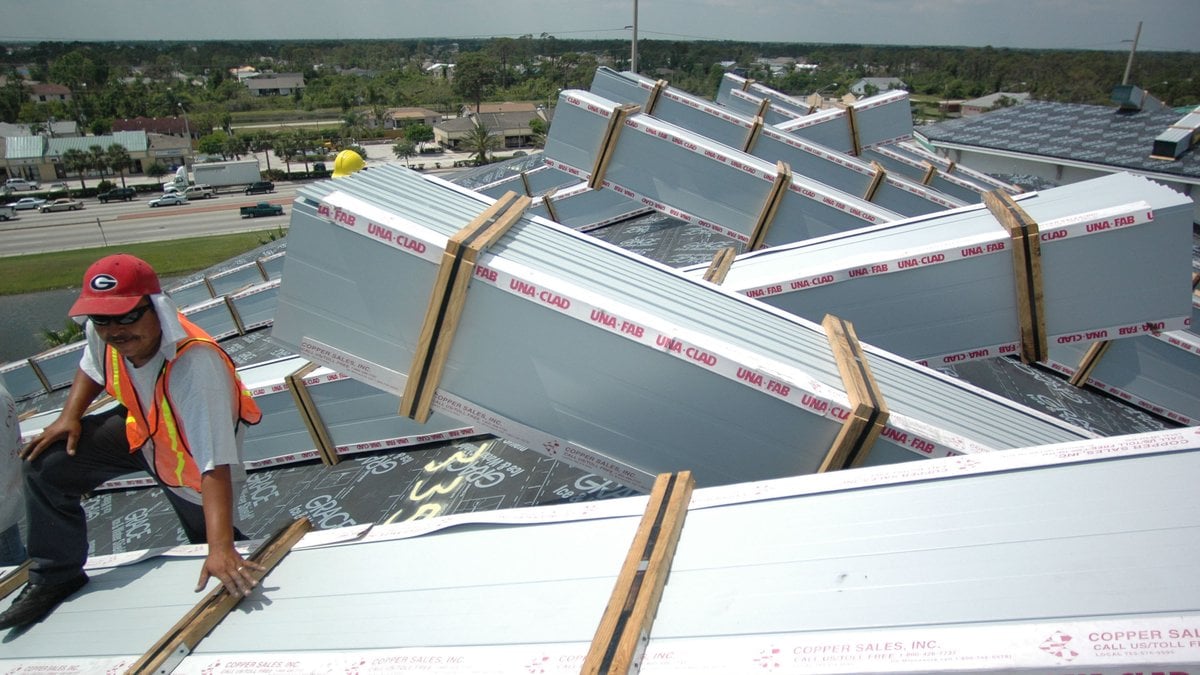
The photo above is Port St. Lucie City Hall in April 2005. Hurricane Frances tore up its concrete tile roof in September 2004, and water got inside. Through FEMA’s Public Assistance and Mitigation programs, the City replaced it with a standing seam metal roof with a higher wind rating, laid over a membrane that seals around every fastener. Your insurer will ask about the same things on your house.
I’ve been in real estate for 17 years, and the insurance quote is one of the first numbers Port St. Lucie buyers ask me about. My Port St. Lucie flood zone checklist covers zone letters, the 30-day wait, repeat-loss areas and the seller’s flood disclosure. This post covers what it doesn’t: how a flood quote is built, private flood, wind paperwork and the City’s 50% rule.
Key takeaways
- Port St. Lucie, unincorporated St. Lucie County, Fort Pierce and St. Lucie Village all use FEMA flood maps effective February 19, 2020.
- Port St. Lucie and unincorporated St. Lucie County are both Community Rating System Class 5. Fort Pierce is Class 6, and FEMA lists no class for St. Lucie Village.
- Port St. Lucie’s first flood insurance rate map is dated March 15, 1982, which matters for the NFIP’s Pre-FIRM discount.
- Citizens can’t sell flood insurance, but it requires flood coverage on wind policies effective on or after January 1, 2027.
- The City adds up flood-zone improvements over the life of the house, starting with the first permit after February 16, 2012.
Port St. Lucie insurance and flood facts at a glance
| Question | Answer (as of November 20, 2026) |
|---|---|
| Current FEMA flood maps | Effective February 19, 2020, for Port St. Lucie and all of St. Lucie County |
| Port St. Lucie CRS class | Class 5, effective April 1, 2023: 25% off in high-risk zones, 10% elsewhere |
| Unincorporated St. Lucie County CRS class | Class 5, effective April 1, 2024 (25%) |
| Fort Pierce and St. Lucie Village | Fort Pierce Class 6 (20%); St. Lucie Village no CRS class |
| Port St. Lucie’s first flood insurance rate map | March 15, 1982 |
| NFIP maximums for a home | $250,000 building, $100,000 contents |
| NFIP fees on a primary home | $25 HFIAA surcharge, $47 Federal Policy Fee, 18% Reserve Fund Assessment, ICC premium up to $75 |
| Citizens flood requirement, all remaining wind policies | Policies effective on or after January 1, 2027 |
| Wind mitigation form | OIR-B1-1802, updated effective April 1, 2026, valid up to five years |
| 50% rule look-back inside the City | Life of the structure, from the first permit after February 16, 2012 |
| My Safe Florida Home applicant portal | Closed November 10; new portal expected December 4, 2026 |
| City Building Department | 772-871-5132 |
What water drives flood risk in Port St. Lucie?
Rain, canals and the North Fork of the St. Lucie River drive it. The City’s flood page names the St. Lucie River, the many canals that empty into it and rain. Port St. Lucie and the rest of St. Lucie County use FEMA flood maps effective February 19, 2020, so older flood paperwork may show a different zone.
The South Florida Water Management District runs the big canals. It says C-24 drains into the North Fork, and its S-49 gates, built in 1960 between Florida’s Turnpike and Port St. Lucie Boulevard, move C-24 water to the coast instead of into streets and homes. The C-23 canal reaches the river near Bessey Creek in Palm City.
So I look at where a lot drains as well as its zone letter. River Place sits on the North Fork, some River Vista homes are along the river, Tesoro Club is near the river and Portofino Isles is a waterfront community. You can pull the zone on the FEMA Flood Map Service Center. My moving to Port St. Lucie, FL guide explains how evacuation zones differ from flood zones.
How does Port St. Lucie’s flood discount compare with the rest of St. Lucie County?
Port St. Lucie and unincorporated St. Lucie County are both Class 5 in FEMA’s Community Rating System, which means 25% off NFIP premiums in high-risk zones. FEMA’s Community Information System lists Fort Pierce at Class 6 with 20% and St. Lucie Village with no class. Tradition and St. Lucie West are inside city limits.
The City’s Flood Mitigation and Insurance page says the Class 5 discount applies as of April 1, 2023: 25% inside the Special Flood Hazard Area and 10% outside it. FEMA lists the County’s Class 5 rating as effective April 1, 2024. FloodSmart says the CRS discount applies to every eligible policy in the community, whatever the flood zone.
In Stuart, FEMA lists no class for the City, as my Stuart flood zones and home insurance guide explains. Here the City and County match, so the city line matters more on your Port St. Lucie property taxes than on flood. Jupiter works the same way, with the Town and unincorporated Palm Beach County both at Class 5, as my Jupiter flood zones and home insurance guide explains.
What goes into an NFIP flood quote on a Port St. Lucie house?
FloodSmart says the NFIP prices each building on where it sits, how it’s built and how much coverage you buy. Where means distance to water, ground elevation and the community’s CRS discount. How means foundation type, first floor height, construction and whether equipment sits above the first floor. Then fees and surcharges are added.
The FloodSmart premium page lists those add-ons. An Increased Cost of Compliance premium is 1.9% of the building and contents premiums, capped at $75. The Reserve Fund Assessment is 18% of the discounted premium. A primary residence pays a $25 HFIAA surcharge, and other homes pay $250. Most policies also carry a $47 Federal Policy Fee. FloodSmart says renewal premiums can’t rise more than 18% to 25% a year for most policyholders, but that cap usually doesn’t apply to new policies.
Two discounts are worth asking about on older Port St. Lucie homes. FloodSmart lists a Pre-FIRM discount for primary residences built or improved before December 31, 1974, or before the community’s first flood insurance rate map. FEMA dates Port St. Lucie’s first map to March 15, 1982. That discount can’t be combined with the annual increase cap. The NFIP also gives mitigation discounts for raising machinery and equipment and for proper flood openings.
An elevation certificate doesn’t set the rate, FloodSmart says, but it can identify discounts. St. Lucie County says some existing certificates are on the Florida Division of Emergency Management’s flood information site. Inside the City, ask the Building Department at 772-871-5132.
NFIP or private flood: what changes under Florida law?
Section 627.715, Florida Statutes, lets private insurers sell five kinds of flood policies. Standard flood must match the NFIP policy, deductibles included. Preferred adds living expenses and replacement cost on contents. Flexible flood can cap coverage at the mortgage balance or pay actual cash value, so read the declarations page before you compare prices.
The statute adds two protections. An owner leaving NFIP coverage for private flood signs a notice that the full-risk rate may apply if they later return to a subsidized NFIP policy. An insurer can also have the Office of Insurance Regulation certify that a policy meets federal private flood requirements. Ask your lender before you bind one.
The same statute says Citizens Property Insurance Corporation can’t write flood. Under section 627.351(6)(aa), Citizens still requires flood coverage from the NFIP or a private carrier on wind policies effective on or after January 1, 2027. Policies without wind and condo unit owner policies are exempt. Citizens’ newsletter notes that private home insurers aren’t required to ask for flood, so compare total cost.
How do the roof, wind mitigation and hurricane deductible change a Port St. Lucie quote?
The roof permit date, a wind mitigation report on form OIR-B1-1802 and the hurricane deductible you choose all move the wind price. Florida insurers have to file wind mitigation discounts. They can’t refuse or nonrenew a home only because the roof is under 15 years old, and they must offer several hurricane deductibles.
The Office of Insurance Regulation updated the wind mitigation form effective April 1, 2026. A report is good for up to five years if the house hasn’t changed and nothing on it is wrong. Section 627.0629 requires the discounts. Under section 627.7011, a roof 15 years or older can be inspected at the owner’s expense. If the inspection shows 5 years or more of useful life remaining, the insurer can’t refuse the policy only because of roof age.
Section 627.701 requires hurricane deductible options of $500, 2%, 5% and 10% of the dwelling limit, applied once per calendar year. On a $350,000 dwelling limit, 2% is $7,000 and 10% is $35,000.
My Safe Florida Home offers hurricane mitigation inspections and grants, but its applicant portal closed November 10, and the program’s notice expects the new one December 4, 2026. Under section 215.5586, a grant home needs a homestead exemption, an insured value of $700,000 or less and a build date before January 1, 2008. Most grants are matched $1 from the owner for every $2 from the state. File homestead first with my homestead filing guide.
How does Port St. Lucie count the 50% rule?
In a high-risk flood zone, work that adds up to 50% of the building’s market value is a substantial improvement, and the whole house then has to meet flood rules for new construction. Port St. Lucie counts improvements over the life of the structure, starting with the first permit issued after February 16, 2012.
That definition is in City Code Chapter 152, and the City Council’s April 8, 2019 agenda packet for Ordinance 19-23 has the full text. If a house has substantial damage, any repair counts as a substantial improvement, whatever the work is. Unincorporated St. Lucie County also adds up repairs and improvements over the life of the building, according to its Flood Protection Information page.
For a buyer in a high-risk zone, a permitted 2015 kitchen and a 2021 addition can count toward the next project. Planning a big remodel? Pull the permit history and price the plan against that line during your inspection period. After a flood, the City asks owners to call the Building Department at 772-871-5132 about substantial damage rules. The City notes that a flood policy may also pay Increased Cost of Compliance money to help elevate a home.
What should Port St. Lucie buyers and sellers do after the November 2026 flooding?
Report any damage and keep the paperwork. St. Lucie County’s preliminary flood damage survey is open countywide, including Port St. Lucie, until November 30, 2026. The City’s SHIP Disaster Relief Program stopped taking new applications on November 9 because of high volume, and the City says updates will be posted on its program page.
The County’s survey, shared by the City on November 17, takes one entry per damaged building and isn’t an aid application. County Community Services is at 772-462-1777. The City’s Disaster Relief Program offers up to $25,000 in 0% deferred loans, and Neighborhood Services is at 772-344-4084.
Sellers, the Florida flood disclosure under section 689.302 asks whether you’ve received assistance for flood damage, including FEMA help. If you took a City disaster loan for flood repairs, ask your real estate attorney how to answer that question. My Port St. Lucie seller guide shows where the flood papers go in a listing packet.
If you’re weighing Tradition against St. Lucie West, my Tradition vs. St. Lucie West comparison covers how both came through the November 2 storm. Listen to the episode: Tradition vs. St. Lucie West on YouTube.
My take on Port St. Lucie insurance and flood
Port St. Lucie has one real advantage over Stuart: the City and the County both carry Class 5, so the flood discount doesn’t change at the city line. What changes from house to house is the roof date, the first floor height and the permit history. I want all three in the first week of the inspection period.
See my Port St. Lucie area guide, the St. Lucie County area guide and my Port St. Lucie buyer guide. To browse listings, use my Port St. Lucie homes for sale on Connect, Tesoro Club on Connect or the St. Lucie County home search.
Frequently asked questions
Do Fort Pierce and St. Lucie Village get the same flood discount as Port St. Lucie?
No. FEMA’s Community Information System, retrieved November 20, 2026, lists Port St. Lucie at Class 5 with a 25% discount and Fort Pierce at Class 6 with 20%. It shows no Community Rating System class for the Town of St. Lucie Village. Unincorporated St. Lucie County is Class 5, like the City.
Can Citizens sell me a flood policy for my Port St. Lucie home?
No. Section 627.715, Florida Statutes, bars Citizens Property Insurance Corporation from writing flood coverage. Citizens still requires flood on wind policies effective on or after January 1, 2027, so the flood policy has to come from the National Flood Insurance Program or a private insurer. Condo unit owner policies and policies without wind are exempt.
Could an older Port St. Lucie home qualify for the Pre-FIRM flood discount?
It might, if it’s your primary residence. FloodSmart lists a Pre-FIRM discount for homes built or improved before December 31, 1974, or before the community’s first flood insurance rate map, which FEMA dates to March 15, 1982 for Port St. Lucie. The discount can’t be combined with the annual increase cap, so ask your agent which applies.
What fees are added to an NFIP flood premium?
FloodSmart lists a Reserve Fund Assessment of 18% of the discounted premium and an HFIAA surcharge of $25 for a primary residence or $250 for other homes. Most policies also pay a $47 Federal Policy Fee. The Increased Cost of Compliance premium is 1.9% of the building and contents premiums, capped at $75.
Will my lender accept a private flood policy?
Ask your lender before you bind it. Florida law lets an insurer ask the Office of Insurance Regulation to certify that a policy meets the federal private flood requirements, and the insurer can note that on the declarations page. If you’re leaving NFIP coverage, you’ll first sign a notice about the full-risk rate.
How much is homeowners insurance in Port St. Lucie?
Florida’s Office of Insurance Regulation, in its July 1, 2026 Property Insurance Stability Report, lists a St. Lucie County average of $3,491 a year for homeowners policies with wind coverage, as of March 31, 2026. Policies without wind averaged $1,932. Those are countywide averages, not a quote for one Port St. Lucie house.
Thinking about buying or selling in Port St. Lucie?
Send me the address and I’ll help you line up the flood zone, the permit history, the roof date and the wind mitigation report before you make an offer or set a price. Call or text me at 772.475.5371, or reach me through my contact page.
About the author
Jeremy Beckham, REALTOR®/SFR with NextHome Treasure Coast, has spent 17 years helping buyers and sellers from Fort Pierce through Martin County and south through Palm Beach County to Boca Raton. His office is at 414 S Colorado Ave in Stuart. See how I source my numbers.
This post is general information, not legal, insurance or financial advice. Flood maps, community ratings, insurance rules, program dates and fees change. Confirm details with the City of Port St. Lucie, St. Lucie County, FEMA, Citizens, your insurance agent and your own advisor.
Sources
- City of Port St. Lucie, Flood Mitigation and Insurance (St. Lucie River and canals, Class 5 with 25% and 10% as of April 1, 2023, substantial damage calls to the Building Department at 772-871-5132, Increased Cost of Compliance, Chapter 152)
- City of Port St. Lucie, Disaster Relief Program (applications paused, up to $25,000, 772-344-4084) and County extends flood impacts survey, published November 17, 2026 (survey open until November 30, 772-462-1777)
- City of Port St. Lucie, City Council agenda packet for Ordinance 19-23, April 8, 2019 (Chapter 152 floodplain management text), definition of substantial improvement with the February 16, 2012 start date
- St. Lucie County, Flood Protection Information (CRS participation, NFIP since 1981, coverage maximums, substantial improvement over the life of the building, elevation certificates through FDEM or Planning and Development Services)
- FEMA, Community Information System, Florida community status report, retrieved November 20, 2026 (Port St. Lucie CID 120287: first FIRM March 15, 1982, current map February 19, 2020, Class 5, 25%, effective April 1, 2023; St. Lucie County CID 120285: Class 5 effective April 1, 2024; Fort Pierce Class 6, 20%; St. Lucie Village no CRS class)
- FEMA, Flood Map Service Center
- FEMA FloodSmart, Premium Costs (premium variables, ICC, Reserve Fund, HFIAA, Federal Policy Fee, annual increase cap, Pre-FIRM and mitigation discounts, CRS applies regardless of zone), What’s covered ($250,000 and $100,000) and Get an elevation certificate
- South Florida Water Management District, S-49 upgrade release (built 1960, Turnpike to Port St. Lucie Boulevard, C-24 to the coast) and St. Lucie River fact sheet (C-24 to the North Fork, C-23 near Bessey Creek)
- Florida Statutes, sections 627.715 (private flood types, NFIP notice, OIR certification, Citizens barred from flood), 627.351 (Citizens flood requirement and exemptions), 627.0629 (wind mitigation discounts), 627.701 (hurricane deductibles), 627.7011 (roof age), 215.5586 (My Safe Florida Home eligibility and match) and 689.302 (flood disclosure)
- Citizens Property Insurance Corporation, New Flood Requirements Begin January 1
- Florida Office of Insurance Regulation, Wind Mitigation Resources (OIR-B1-1802 effective April 1, 2026, five-year validity)
- Florida Office of Insurance Regulation, Property Insurance Stability Report, July 1, 2026 (St. Lucie County average homeowners premiums as of March 31, 2026: $3,491 with wind, $1,932 without wind)
- My Safe Florida Home, Program Modernization FAQs (portal closed November 10, new portal expected December 4)
Featured photo: Photo by Leif Skoogfors/FEMA, public domain, via Wikimedia Commons. Cropped and resized.