


The short answer: Port St. Lucie property taxes for 2026 add up to 22.0043 mills inside city limits, about $22.00 for every $1,000 of taxable value, down from 22.3097 in 2025. The City sets 4.8750 of those mills. A typical homesteaded City home owes about $4,381 before fees, and paying by November 30, 2026 earns a 4% discount.
By Jeremy Beckham, REALTOR®, SFR | Last updated: November 18, 2026
Watch: Florida Amendment 3, county by county
Short on time? Watch the quick 3-minute version.
St. Lucie County tax bills went out around November 1. I’ve been in real estate for 17 years, and in Port St. Lucie the tax bill is one of the first things I pull for a buyer or a seller.
My Port St. Lucie buyer checklist covers sewer and the trash credit, and St. Lucie County property taxes after Amendment 3 covers 2027. This post covers the 2026 rate line by line, a sample bill, what a buyer pays after the value resets, and the payment calendar. Looking in Jupiter instead? My Jupiter property taxes guide does the same for the Town of Jupiter bill.
Key takeaways
- The 2026 total millage for a City of Port St. Lucie parcel is 22.0043, down 0.3054 from 22.3097 in 2025.
- The City Council controls two lines, its operating rate and the Crosstown Parkway voted debt. The City says those make up about 21% of the bill.
- The City adopted an operating rate of 4.6107 mills, which is 9.91% above its rolled-back rate of 4.1951, while the City’s certified taxable value rose 8.36%.
Port St. Lucie property taxes at a glance
| Question | Answer (as of November 18, 2026) |
|---|---|
| 2026 total millage, City of Port St. Lucie parcel | 22.0043 (22.3097 in 2025) |
| City of Port St. Lucie share | 4.6107 operating plus 0.2643 Crosstown Parkway voted debt = 4.8750 |
| School Board share | 6.2450 (2.9970 state-required plus 3.2480 local) |
| St. Lucie County share on a City parcel | 7.2587 |
| Typical City homestead, 2026 ad valorem taxes | $4,380.91 on $191,598 non-school taxable value |
| City flat fees on most homes | $195 stormwater plus $482.16 solid waste |
| Who sets values | St. Lucie County Property Appraiser, 772-462-1000 |
| Who sends the bill | St. Lucie County Tax Collector, 772-462-1650 |
| Early-payment discount | 4% November, 3% December, 2% January, 1% February |
| Full amount due | March 31, 2027 |
| Delinquent | April 1, 2027 |
| Installment plan sign-up for 2027 taxes | November 1, 2026 to April 30, 2027 |
How is a Port St. Lucie tax bill calculated?
The Property Appraiser sets your assessed value as of January 1 and subtracts your exemptions to get taxable value. Each taxing authority multiplies that taxable value by its millage rate and divides by 1,000. The Tax Collector adds the non-ad valorem fees and mails one combined bill around November 1.
Value and homestead questions go to the Property Appraiser. Payment questions go to the Tax Collector, which has an office in Tradition as well as Fort Pierce.
A Port St. Lucie mailing address doesn’t always mean City limits. Check the taxing district on the parcel record, because unincorporated parcels pay County MSTU lines instead of the City’s.
What is the 2026 millage rate for a Port St. Lucie home?
A City of Port St. Lucie parcel pays 22.0043 mills for 2026. That’s 7.2587 to St. Lucie County, 6.2450 to the School Board, 4.8750 to the City, 3.0000 to the Fire District and 0.6256 to three regional districts. Each line held steady or went down from 2025.
A few City tax districts differ slightly, so check your parcel on the Property Appraiser’s site.
| Taxing authority | 2025 mills | 2026 mills |
|---|---|---|
| St. Lucie County General Fund | 4.1985 | 4.0441 |
| County Fine and Forfeiture (jail, law enforcement) | 2.7294 | 2.7294 |
| Erosion District E, Mosquito Control, County Transit | 0.4852 | 0.4852 |
| School Board, state-required | 3.0480 | 2.9970 |
| School Board, local (discretionary, capital, voter-approved) | 3.2480 | 3.2480 |
| City of Port St. Lucie operating | 4.6607 | 4.6107 |
| Crosstown Parkway voted debt | 0.3143 | 0.2643 |
| St. Lucie County Fire District | 3.0000 | 3.0000 |
| Children’s Services Council | 0.3685 | 0.3685 |
| South Florida Water Management District (three levies) | 0.2301 | 0.2301 |
| Florida Inland Navigation District | 0.0270 | 0.0270 |
| Total | 22.3097 | 22.0043 |
The County adopted its rates on September 17, 2026, with the General Fund at its rolled-back rate of 4.0441. The School Board adopted its 6.2450 total on September 8.
How much of the bill does the City of Port St. Lucie control?
About 21%. The City Council sets two lines: the City operating rate and the voter-approved debt for the Crosstown Parkway. The other 79% comes from the County, the School Board, the Fire District, the Children’s Services Council, the Water Management District and the Florida Inland Navigation District.
The City has lowered its total rate 11 years in a row, from 6.6289 in fiscal year 2015-16 to 4.8750 for 2026-27.
Lower isn’t the same as rolled back, though. The rolled-back rate is the one that would bring in the same tax revenue as last year. For the City that was 4.1951, and the adopted 4.6107 sits 9.91% above it. The City’s certified taxable value rose 8.36%, from $25.6 billion to $27.7 billion.
Why can a Port St. Lucie tax bill go up when the rate goes down?
The bill is rate times value, and value can rise faster than the rate falls. Save Our Homes lets a homestead’s assessed value rise up to 3% a year or the change in the CPI, whichever is lower. Non-homestead property can rise up to 10% a year. A sale or a finished new home moves it more.
Three things push a bill up the most:
- A sale. The buyer starts at full value the next January 1.
- New construction. The City notes a new home’s first assessment may cover only the land. Once the house is finished, it’s reassessed and an escrowed payment can jump.
- A lost exemption. Taxable value rises even if nothing else changes.
What would a 2026 tax bill look like for a typical Port St. Lucie home?
Using the City’s typical homestead, assessed at $243,009 with the full $51,411 homestead exemption, 2026 ad valorem taxes come to $4,380.91. School taxes use a $218,009 taxable value, because only the first $25,000 of homestead applies to school levies. Everything else uses $191,598.
| Line on the bill | 2026 mills | Taxable value | Tax |
|---|---|---|---|
| St. Lucie County (five levies) | 7.2587 | $191,598 | $1,390.75 |
| School Board | 6.2450 | $218,009 | $1,361.47 |
| City of Port St. Lucie operating | 4.6107 | $191,598 | $883.40 |
| Crosstown Parkway voted debt | 0.2643 | $191,598 | $50.64 |
| St. Lucie County Fire District | 3.0000 | $191,598 | $574.79 |
| Children’s Services Council | 0.3685 | $191,598 | $70.60 |
| South Florida Water Management District | 0.2301 | $191,598 | $44.09 |
| Florida Inland Navigation District | 0.0270 | $191,598 | $5.17 |
| Ad valorem total | 22.0043 | $4,380.91 |
That matches the City’s own $4,381 estimate, with $934 going to the City. Add the City’s $195 stormwater fee and $482.16 solid waste assessment, and the full-year amount before discounts and before any one-time trash credit is $5,058.07.
What will a buyer pay after the sale resets the value?
More than the seller, in most cases. After you buy, the Property Appraiser removes the seller’s exemptions and caps and assesses the home at full value the next January 1. You then apply for your own homestead, so the seller’s bill tells you little about yours.
Here’s a simple illustration at 2026 rates. Say the Property Appraiser’s just value on your new home comes in at $331,300, which is the median market value the City reports for a house in Port St. Lucie. With homestead, the ad valorem taxes would be about $6,323.70. Without homestead, as a second home or rental, they’d be about $7,290.02.
That’s why I don’t let a lender escrow off the seller’s bill. Just value isn’t always your price, so I run the Property Appraiser’s Tax Estimator at the offer price with and without homestead. It doesn’t include 2027 law changes or the fee lines.
If you’re selling, my Port St. Lucie seller prep guide covers how taxes and fee lines get split at closing.
What else shows up on a Port St. Lucie tax bill?
Non-ad valorem assessments. These are flat or benefit-based charges, not millage. Every City home pays the stormwater fee and solid waste assessment. Depending on the neighborhood, you may also see a City MSBU, a street lighting district or a community development district.
The Tax Collector’s district list includes City MSBUs such as Glassman and River Point, CDDs for Tradition, Southern Grove, Tesoro and Portofino Isles, and the St. Lucie West Services District.
Two things buyers should know. First, the Tax Collector says a special assessment or MSBU collected on the tax roll follows the property for its full term and doesn’t have to be paid off at a sale or refinance. Second, the discount applies to these lines too. For neighborhood detail, see my Tradition CDD fees guide, my Tradition vs. St. Lucie West comparison, and the Tradition and St. Lucie West area guides.
When are St. Lucie County property taxes due, and how big is the discount?
Bills are mailed on or about November 1 and are due by March 31. Florida law sets the discount at 4% in November, or within 30 days of the original notice, then 3% in December, 2% in January, 1% in February and nothing in March. Unpaid taxes become delinquent April 1.
| Pay in | Discount | Sample ad valorem bill above |
|---|---|---|
| November 2026 | 4% | $4,205.67 |
| December 2026 | 3% | $4,249.48 |
| January 2027 | 2% | $4,293.29 |
| February 2027 | 1% | $4,337.10 |
| By March 31, 2027 | None | $4,380.91 |
You can pay the St. Lucie County Tax Collector online, by mail or in person. If you bought this year, the bill may still be in the seller’s name, so make sure someone pays it.
How do installments and partial payments work in St. Lucie County?
The installment plan splits next year’s taxes into four payments with built-in discounts, but you have to apply by April 30 and your estimated tax must be over $100. Partial payments are different. You can make up to three payments of at least $100 on the current bill between November and March, with no discount.
- June 30: one quarter of the estimated tax, 6% discount.
- September 30: one quarter, 4.5% discount.
- December 30: one quarter plus half of any adjustment to the actual tax, 3% discount.
- March 31: the last quarter plus the rest of the adjustment, no discount.
The window for 2026 taxes closed April 30, 2026. Sign-up for 2027 taxes runs November 1, 2026 to April 30, 2027, and the first payment is due in June 2027. If the estimate matches the final bill, the four discounts average about 3.4%, a bit under the November 4%.
What happens if Port St. Lucie property taxes go unpaid?
On April 1 the taxes become delinquent and interest and fees start to add up. The certificate sale opens for bidding in May. If the balance isn’t received by 5:00 p.m. on the last business day before June 1, the Tax Collector issues a tax certificate on the property.
A certificate doesn’t mean the owner has lost the house, but if it stays unpaid the holder can eventually apply for a tax deed. The Tax Collector can’t take partial payments on delinquent taxes. On estate sales and vacant homes, I check for open years before we list.
Which exemptions lower a Port St. Lucie tax bill?
Homestead is the main one. For 2026 it can take up to $51,411 off a primary residence: the first $25,000 off every levy, plus up to $26,411 more off non-school levies. You apply with the Property Appraiser by March 1. Homestead also starts the Save Our Homes cap the next year.
Moving from another Florida homestead? Portability can carry up to $500,000 of your Save Our Homes benefit when you file. See my homestead filing guide and Florida residency checklist.
Senior, disability and veteran exemptions may also apply, but the estimator leaves them out. Florida’s extra senior exemptions reduce only the lines of governments that adopted them, so ask the Property Appraiser. Owners with low income relative to their taxes can look at the Tax Collector’s Homestead Tax Deferral Program.
What does the TRIM notice tell you, and what if you disagree?
The Property Appraiser mails the TRIM notice, the Notice of Proposed Property Taxes, in August. It isn’t a bill. It shows each authority’s rate and taxes from last year, its rolled-back rate, its proposed rate, the hearing dates and your deadline to challenge the value.
Florida law gives you 25 days from the mailing date to file a petition with the Value Adjustment Board. Call the Property Appraiser at 772-462-1000 first, since a lot of value questions get settled on that call. If you bought in 2026, your new value shows up on the August 2027 notice, so use the estimator until then.
Thinking about Amendment 3?
Amendment 3 passed on November 3, 2026. It raises the homestead exemption on non-school taxes in steps starting in 2027 and cuts the non-homestead cap from 10% to 5%. School taxes aren’t affected.
Before the vote, the City estimated it could lose $48.4 million over two years. I keep the county detail in my St. Lucie County Amendment 3 post, and the Martin County side is in my Stuart property taxes guide.
Frequently asked questions
How much are property taxes on a $300,000 house in Port St. Lucie?
At 2026 City rates, a home with a $300,000 just value and full homestead would owe about $5,634.96 in ad valorem taxes. Without homestead it’s about $6,601.29. Add the City’s $195 stormwater fee and $482.16 solid waste assessment, plus any MSBU or CDD lines for that neighborhood.
What is the total millage rate in Port St. Lucie for 2026?
A parcel inside City of Port St. Lucie limits pays 22.0043 mills for 2026, or about $22.00 per $1,000 of taxable value. That’s down from 22.3097 in 2025. The City’s own share is 4.8750, the School Board’s is 6.2450 and St. Lucie County’s is 7.2587.
What is the Crosstown Parkway line on my Port St. Lucie tax bill?
It’s the City’s voter-approved debt levy, which pays for the Crosstown Parkway. For 2026 it dropped to 0.2643 mills from 0.3143. On the City’s typical homestead, that line comes to $50.64. It’s one of only two lines on the bill that the City Council sets.
When is the last day to get the 4% discount on St. Lucie County property taxes?
November 30, 2026, for bills mailed around November 1. Florida law gives 4% in November or within 30 days after the original notice is sent. After that the discount is 3% in December, 2% in January and 1% in February. March payments get no discount.
Can I sign up for the St. Lucie County property tax installment plan now?
Yes, for 2027 taxes. The Tax Collector takes applications online from November 1, 2026 to April 30, 2027, and the first payment is due in June 2027. Your estimated tax must be over $100, and past-due taxes can’t go on the plan.
Does a City special assessment have to be paid off when I sell my Port St. Lucie home?
No. The St. Lucie County Tax Collector says a special assessment or MSBU collected on the tax roll follows the property for its full term. It doesn’t have to be paid off at a sale or refinance. Your contract and closing agent decide how the current year’s amount gets split.
My take on Port St. Lucie property taxes
For a buyer, the reset value after a sale moves the bill far more than any rate change. When I walk a buyer through taxes, I pull the parcel record to confirm City limits, run the estimator at our offer price with and without homestead, and add every fee line from the current bill.
Browse my Port St. Lucie home search or St. Lucie County home search, or read my Port St. Lucie area guide. Related: moving to Port St. Lucie, FL, my Port St. Lucie flood zone checklist, my Port St. Lucie home insurance and flood zones guide, my Port St. Lucie schools guide and what Florida sellers pay at closing.
Thinking about buying or selling in Port St. Lucie?
Send me the address and I’ll build the tax estimate with the real fee lines before you make an offer or set a price. Call or text me at 772.475.5371, or reach me through my contact page.
About the author
Jeremy Beckham, REALTOR®/SFR with NextHome Treasure Coast, has spent 17 years helping buyers and sellers from Fort Pierce through Martin County and south through Palm Beach County to Boca Raton. His office is at 414 S Colorado Ave in Stuart. See how I source my numbers.
This post is general information, not legal, tax or financial advice. Rates, exemptions, fees and deadlines change. Confirm details with the St. Lucie County Property Appraiser, the Tax Collector and your own advisor.
Sources
- City of Port St. Lucie, Taxes: Your City Tax Bill Explained (21% City share, $4,381 average and $934 City portion, $51,411 homestead, Save Our Homes and portability, new construction, millage history) and FY 26/27 Adopted Budget in Brief (4.6107 operating, 0.2643 voted debt, 8.36% taxable value increase, typical homestead example, $195 stormwater, $482.16 solid waste, $331,300 median market value, General Fund revenue mix), November 18, 2026
- City of Port St. Lucie, Amendment 3: What Florida Voters Should Know (revenue loss estimates and homestead share, published before the vote)
- St. Lucie County Property Appraiser, Taxing Authority Rates and Hearing Information (2025 final, 2026 rolled-back and proposed rates, hearing dates) and Tax Estimator
- St. Lucie County Board of County Commissioners, September 17, 2026 final millage hearing minutes and Resolution 2026-181 agenda item
- St. Lucie Public Schools, 2026-27 District Summary Budget (6.2450 total mills)
- St. Lucie County Fire District, Independent Special District Information (ad valorem taxes at 3.0 mills)
- Children’s Services Council of St. Lucie County, September 21, 2026 final hearing minutes (0.3685 final millage)
- South Florida Water Management District, Final Public Hearing on FY 2026-2027 Final Millage Rates agenda (0.0948, 0.1026 and 0.0327 mills)
- Nassau County Property Appraiser, Florida Inland Navigation District 2026 final millage history (0.0270 for 2026)
- St. Lucie County Tax Collector, Discounts and Payment Plans, Delinquent Property Taxes, Taxing and Levying Authorities, Special Assessments, Ad Valorem Taxes and Non-Ad Valorem Assessments, Learn the Basics and Non-Ad Valorem District list, November 18, 2026
- Florida Department of Revenue, Additional Homestead Exemption Adjustment ($26,411 for 2026)
- Florida Statutes, sections 194.011 (25-day petition window) and 197.162 (discounts)
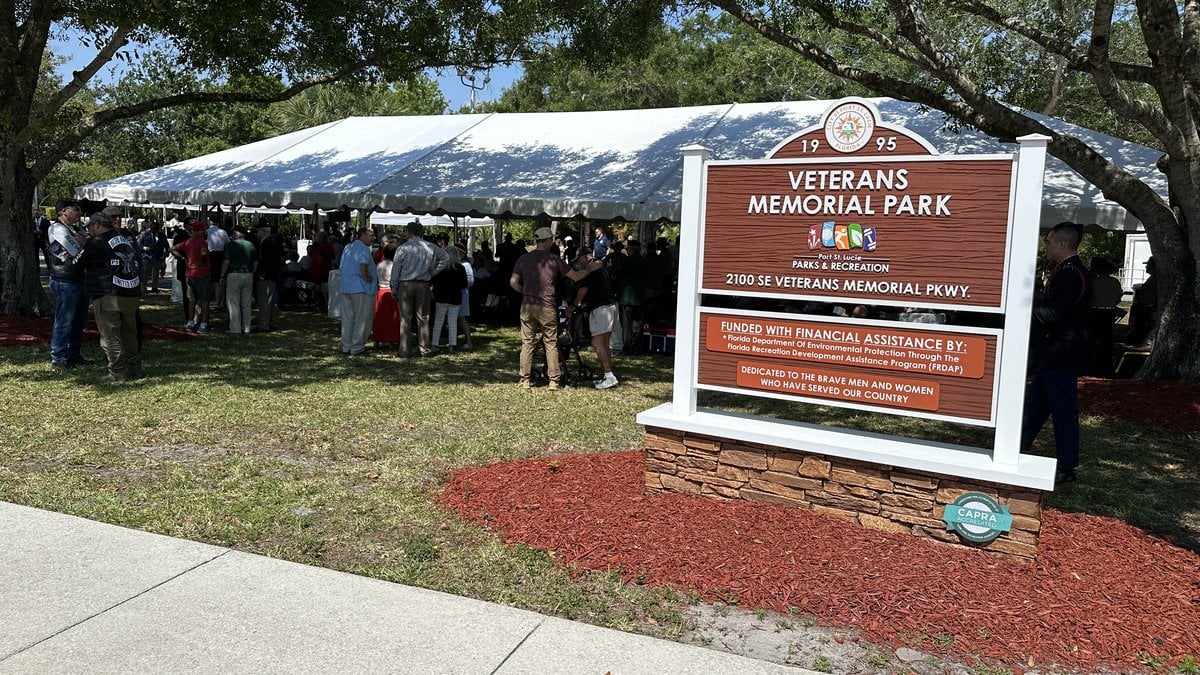
Featured photo: the Veterans Memorial Park sign on SE Veterans Memorial Parkway, a Port St. Lucie Parks and Recreation park, photographed April 20, 2024 by Leonard J. DeFrancisci, via Wikimedia Commons, licensed under CC BY-SA 4.0. Cropped and resized.