


The short answer: To prove Florida residency by December 31, 2026, line up the records property appraisers already ask for. That means a Florida driver license or ID, Florida vehicle registration, and Florida voter registration or a recorded declaration of domicile. Then own and live in the home on January 1 and file for homestead by March 1.
By Jeremy Beckham, REALTOR®, SFR | Last updated: November 16, 2026
If you’re moving to the Treasure Coast or the Palm Beaches this winter, December 31, 2026 is the date to plan around. Amendment 3 passed on November 3, and its larger homestead exemption depends on when you became a permanent Florida resident. I’ve worked in real estate for 17 years, and the people who get homestead right are the ones who get their paperwork in order early.
This checklist uses only what the Florida Department of Revenue, the Florida Statutes and six county property appraisers have published. The filing steps after you close are in my homestead filing guide, and the full Amendment 3 story is in Florida Amendment 3 Passed: Why December 31, 2026 Matters.
Key takeaways
- The Florida Department of Revenue says people who are not Florida residents as of December 31, 2026 start with the old exemption amounts and get the larger one in their fifth year of exemption.
- Residency and homestead are two separate tests. Homestead still requires that you own the home and make it your permanent residence on January 1, then file by March 1.
- No single document proves residency. Section 196.015 of the Florida Statutes lists ten factors the property appraiser may weigh.
- Every county uses the same state application, Form DR-501, but each property appraiser posts its own document list. The county table below lines them up side by side.
- The Palm Beach County Property Appraiser says the Legislature may still issue guidance on residency documentation, so check back before you file.
Why does December 31, 2026 matter for homestead?
Amendment 3 ties the bigger exemption to residency. The Florida Department of Revenue says people who are not Florida residents as of December 31, 2026 receive a $25,000 exemption for school taxes and up to $50,000 for non-school taxes once they qualify. They become eligible for the increased exemption in their fifth year of exemption.
For people who are permanent Florida residents by that date, the same Department of Revenue bulletin says the non-school exemption covers assessed value up to $150,000 in 2027 and up to $250,000 in 2028, with inflation adjustments after that. The amendment takes effect January 1, 2027.
The Palm Beach County Property Appraiser adds two cautions. The residency provisions are subject to federal constitutional requirements and may be affected by future legislation, legal challenges or court decisions. And the Florida Legislature may issue more guidance on residency documentation and eligibility. Nobody can give you a final document list for the December 31 test yet, so the safest plan is to use the residency proof the property appraisers already use for homestead.
Is residency the same as owning a home on January 1?
No, they are two separate tests. Residency by December 31, 2026 decides which Amendment 3 exemption schedule applies to you. Homestead itself requires that on January 1 you hold title to the home and make it your permanent residence, under section 196.031 of the Florida Statutes, and that you file with your county property appraiser by March 1.
Section 196.011 says that missing the March 1 filing date waives the exemption for that year, with limited late-filing exceptions. Under section 196.011(9), a late application must be filed within 25 days after the property appraiser mails the Notice of Proposed Property Taxes, and you need to show extenuating circumstances. The Martin County Property Appraiser explains this same window to applicants.
Martin County’s office also clears up a common belief. There is no rule that you live in the home a certain number of months each year to qualify.
What does Florida law say counts as proof of permanent residency?
Section 196.015 says the property appraiser decides residency as a question of fact, and no single item settles it. The law lists ten factors the appraiser may weigh, including a recorded declaration of domicile, a Florida driver license, Florida voter registration at the homestead address, a Florida tag, your tax return address and utility bills.
Here is the full list from the statute, in plain words:
- A formal declaration of domicile recorded in the county where you seek the exemption.
- Where your dependent children are registered for school.
- Where you work.
- Your previous permanent residence outside Florida and the date that residency ended.
- Florida voter registration, with the voter card address matching the homestead.
- A valid Florida driver license or Florida ID card, plus evidence you gave up driver licenses from other states.
- A Florida license tag on any vehicle you own.
- The address on your federal income tax returns.
- Where your bank statements and checking accounts are registered.
- Proof you pay the utilities at the property.
The statute also says valid military orders transferring a member of the U.S. Armed Forces are enough to keep permanent residence for the member and spouse.
What is a declaration of domicile, and do I need one?
A declaration of domicile is a sworn statement, filed with the clerk of the circuit court in the county where you live, that your Florida home is your permanent home. Section 222.17 of the Florida Statutes sets it up. It is one residency factor, and some property appraisers accept it in place of Florida voter registration.
The Martin County Property Appraiser says you may file a declaration of domicile instead of registering to vote, but you still may not be registered to vote anywhere else. The Palm Beach County Property Appraiser lists a declaration of domicile as one of the items that can go with your Florida driver license. If you keep a home in another state too, section 222.17 lets you swear that your Florida home is your predominant and principal home.
What does each county property appraiser ask for?
Every county uses the same state application, Form DR-501, but each property appraiser posts its own document list. The core is the same everywhere. You’ll need a Florida driver license or ID, Social Security numbers for each applicant and spouse, and residency proof such as Florida vehicle and voter registration at the homestead address.
| County | What the property appraiser asks for | How to file | Contact |
|---|---|---|---|
| Martin | Florida voter registration, Florida driver license or ID, Florida vehicle registration if you own or drive a vehicle here, Social Security numbers for you and your spouse, a trust certificate if the home is in a trust, and a permanent resident card if you are not a U.S. citizen | Online, in person in Stuart or Hobe Sound, by appointment in Indiantown, or by mail | (772) 288-5608, How to Apply |
| St. Lucie | Florida driver license, Social Security numbers for you and your spouse, a permanent resident card if you are not a U.S. citizen, a copy of the entire trust if the home is in one, plus the date you became a permanent resident, your occupancy date and the address on your last tax return. Proof of residency should be dated before January 1 | Online or in person in Fort Pierce or St. Lucie West. Pre-filing is accepted | 772-462-1000, Learn About Exemptions |
| Palm Beach | Social Security numbers for applicants and spouses, a valid Florida driver license (Florida ID for non-drivers), a permanent resident card if not a U.S. citizen, plus any one of these: Florida vehicle registration, Florida voter registration at the homestead address, a declaration of domicile, a federal tax return or utility bills from the home | E-File, at a service center, or by mailing Form DR-501 | 561-355-2866, Homestead Exemption |
| Indian River | The state Form DR-501, which asks for your Florida driver license or ID number, Florida tag number, Florida voter registration number, any declaration of domicile date, your employer and the address on your last IRS return | Online through the Property Appraiser’s online forms (find your parcel, then choose Homestead Application) | (772) 226-1469 Vero Beach, (772) 226-1133 Sebastian, Exemptions |
| Broward | Recorded deed in the applicants’ names, a Florida driver license (or Florida ID for non-drivers) with any out-of-state license surrendered, plus either Florida voter registration or a power or water bill for the home in an owner’s name. Proof is preferably dated before January 1 | Online, at the office or at a Mobile Exemption Education Team event | 954-357-6830, Homestead |
| Brevard | Florida driver license, or a Florida ID if you do not drive; Florida vehicle registration for all vehicles you own, lease, or register to your business; a Brevard County voter registration card if you are registered to vote; Social Security documents for you and your spouse; a copy of the recorded deed or tax bill; and, if you own property elsewhere, a letter verifying you do not receive a residency-based tax benefit there. Also a permanent resident card if you are not a U.S. citizen, a trust agreement or recorded memorandum of trust if the property is in a trust, and the registration or title if it is a manufactured home | Online, by mail or in person at any of four offices | Exemptions |
Martin County
The Martin County Property Appraiser’s Amendment 3 handout names a Florida driver license, Florida voter registration and Florida vehicle registration as examples of documents used to determine permanent residency. Its general information page says to cancel any out-of-state residency-based tax benefit, such as New York’s STAR, effective January 1 of the year you apply. It also says you can’t keep a driver license from another state or be registered to vote somewhere else. Buying in Stuart, Palm City or Jensen Beach? Read Martin County property taxes after Amendment 3 and my Stuart area guide, or browse Martin County homes for sale.
St. Lucie County
The St. Lucie County Property Appraiser asks that all proof of residency be dated before January 1, and it accepts pre-filed applications during the year. It also reminds owners that homestead doesn’t transfer. If you buy a new home or change the title, for example by adding a spouse or moving the home into a trust, you reapply. Its Know Your Ballot page collects its Amendment 3 information. Buying in Port St. Lucie, Tradition or Fort Pierce? Read St. Lucie County property taxes after Amendment 3 and my Port St. Lucie area guide, or browse St. Lucie County homes for sale.
Palm Beach County
The Palm Beach County Property Appraiser says that as of January 1 you must be a permanent Florida resident, hold title, make the home your permanent residence and have no residency-based benefits elsewhere. Its Amendment 3 calculator page says someone who was a Florida resident by December 31, 2026 but buys a first home in 2027 may still qualify for the larger exemption, and still has to apply. Read Palm Beach County property taxes after Amendment 3 and my Jupiter area guide, or browse Palm Beach County homes for sale.
Indian River County
The Indian River County Property Appraiser’s home page says that applications submitted since September 6 count for the 2027 tax year. It also says permanent Florida residency is required on January 1 and the application is due by March 1. The pages linked here don’t include a separate document checklist, so call the Vero Beach or Sebastian office before you go, and bring the items Form DR-501 asks for. Read Indian River County property taxes after Amendment 3, or browse Indian River County homes for sale.
Broward County
The Broward County Property Appraiser says the timely filing period for 2027 homestead runs from March 3, 2026 through March 1, 2027, and the absolute late-filing deadline for 2027 is September 20, 2027. It also says you are not eligible while you or your spouse hold a homestead or a residency-based tax credit on another property, in Broward or anywhere else, until you cancel it. Read Broward County property taxes after Amendment 3 and my Coral Springs area guide, or browse Broward County homes for sale.
Brevard County
The Brevard County Property Appraiser says applications can go in any time of year but must be in by March 1 for that year’s benefit, and the exemption renews each year as long as ownership and residence stay the same. Its Amendment 3 FAQ says people who become Florida residents on or after January 1, 2027 start at $50,000. They become eligible for the larger exemption on January 1 of their fifth year. Read Brevard County property taxes after Amendment 3, or browse Brevard County homes for sale.
What should I do between now and December 31?
Start with the items the counties ask for most often. Martin, St. Lucie, Palm Beach, Broward and Brevard all list a Florida driver license or Florida ID, so get that first. Then line up your vehicle registration, your voter registration or declaration of domicile, and the other residency factors in section 196.015, and keep dated copies of each.
- Get your Florida driver license or Florida ID card. Section 196.015 counts evidence that you gave up other states’ licenses, and Broward says to surrender any out-of-state license.
- Register your vehicles in Florida. Brevard asks for every vehicle you own or lease, and Martin asks if you own or drive one here.
- Register to vote at your Florida address, or record a declaration of domicile with the clerk of the circuit court.
- Cancel any residency-based tax break in another state, such as New York’s STAR. Martin says to do it effective January 1 of the year you apply.
- Move your tax return address, your bank statements and your utilities to the Florida home. Each is a factor in section 196.015.
- Close on the home and make sure the deed is recorded. Section 196.031 requires title and permanent residence on January 1.
- File your homestead application by March 1, 2027. Every county on this list takes it online.
- Keep copies of everything with dates on them. St. Lucie asks for proof dated before January 1, and Broward prefers it.
What if I can’t close on a home before December 31?
Residency and buying are separate steps. The Palm Beach County and Brevard County property appraisers both say a Florida resident as of December 31, 2026 who buys later may still qualify for the larger exemption after buying and applying. If you won’t own by January 1, 2027, ask your property appraiser how to document residency meanwhile.
If you close after January 1, 2027, your first homestead year moves to 2028, because section 196.031 looks at who owns and lives in the home on January 1. The St. Lucie and Brevard offices both accept applications filed ahead of time, so you can file as soon as you qualify.
My take as a local Realtor
My honest advice is to work on the paperwork now and not rush the house. You control the license, the tag and the voter card this month. You don’t control inventory, appraisals or a seller’s timeline. I’d rather see you set up residency on time and buy the right home in the spring than buy the wrong one in December to beat a date.
I also tell clients not to lean on anything that isn’t in writing from the state or the property appraiser yet. The rules for the December 31 test could still get more detail from the Legislature. Keep your copies, check your county’s page again in January, and file the minute you qualify.
Frequently asked questions
Does buying a Florida home by December 31 make me a Florida resident?
Not by itself. Section 196.015 says permanent residency is a factual decision by the property appraiser, based on factors such as your Florida driver license, voter registration, vehicle tag, tax return address and utility bills. Owning a home helps, but the property appraiser weighs all of those records together when you apply for homestead.
Can I keep my out-of-state driver license and still get homestead?
Generally no. The Martin County Property Appraiser lists keeping a driver license from another state as something that can cost you the exemption, and the Broward County Property Appraiser says to surrender any out-of-state license. Section 196.015 also counts evidence that you gave up licenses from other states as a residency factor.
What if my proof of residency is dated after January 1?
It can cause problems. The St. Lucie County Property Appraiser says all proof of residency should be dated before January 1, and the Broward County Property Appraiser prefers proof dated before January 1 of the tax year. Get your license, tag and voter registration done in December so the dates line up with your filing.
Can I file my 2027 homestead application now?
Yes, in several counties. Broward’s timely filing period for 2027 opened March 3, 2026. Indian River says applications submitted since September 6 count for 2027. Brevard accepts applications any time of year, and St. Lucie accepts pre-filed applications. You still must own the home and live there on January 1, 2027.
Do I have to live in my Florida home a certain number of months to qualify?
No. The Martin County Property Appraiser says there is no requirement to live on the property a set number of months each year. What counts is that you own the home and make it your permanent residence on January 1, and that you don’t claim a residency-based tax benefit anywhere else.
What happens if I miss the March 1, 2027 homestead deadline?
Section 196.011 says missing March 1 waives the exemption for that year, with limited exceptions. Section 196.011(9) sets a 25-day late window after the Notice of Proposed Property Taxes is mailed, with extenuating circumstances shown. Martin County explains this same window. Broward lists September 20, 2027 as its absolute late-filing deadline. File well before March 1.
Thinking about moving to Florida before December 31?
I’ll help you build a residency checklist for the county you’re buying in, set a closing date that works with January 1, and send you the property appraiser’s filing steps in writing after closing. Call or text me at 772.475.5371.
About the author
Jeremy Beckham, REALTOR®/SFR with NextHome Treasure Coast, has spent 17 years helping buyers and sellers from Fort Pierce through Martin County and south through Palm Beach County to Boca Raton. His office is at 414 S Colorado Ave in Stuart. See how I source my numbers, my relocation page, or the Florida home buyers guide.
This post is general information, not legal or tax advice. Amendment 3 implementing rules may change, and each property appraiser makes the final residency decision. Confirm your situation with your county property appraiser and a Florida attorney or tax advisor.
Sources
All sources accessed November 16, 2026.
- Florida Department of Revenue, Property Tax Oversight Bulletin PTO 26-21, Constitutional Amendment 3 (PDF) (approved November 3, 2026; $150,000 in 2027 and $250,000 in 2028 for non-school taxes; non-residents as of December 31, 2026 get $25,000 school and up to $50,000 non-school, larger exemption from the fifth year; effective January 1, 2027)
- Florida Senate, HJR 1-F, enrolled text (PDF)
- Florida Statutes, Section 196.015, Permanent residency; factual determination by property appraiser (ten factors; military orders)
- Florida Statutes, Section 196.031, Exemption of homesteads (title and permanent residence on January 1)
- Florida Statutes, Section 196.011, Annual application required for exemption (file on or before March 1; waiver; 25-day late-filing window in subsection (9))
- Florida Statutes, Section 222.17, Manifesting and evidencing domicile in Florida (sworn statement filed with the clerk of the circuit court)
- Florida Department of Revenue, Form DR-501, Original Application for Homestead and Related Tax Exemptions (PDF) (proof of residence fields)
- Martin County Property Appraiser, Homestead Exemption General Information, How To Apply, Information Required for Homestead Exemption Application (PDF) and Amendment 3 Passed: What Happens Now (PDF)
- St. Lucie County Property Appraiser, Learn About Exemptions and Know Your Ballot
- Palm Beach County Property Appraiser, Homestead Exemption and Amendment 3 Calculator and FAQ
- Indian River County Property Appraiser, home page, Online Forms and Exemptions
- Broward County Property Appraiser, Homestead Exemption (2027 and 2028 filing periods, late-filing deadlines, required documents)
- Brevard County Property Appraiser, Exemptions and Amendment 3 FAQ
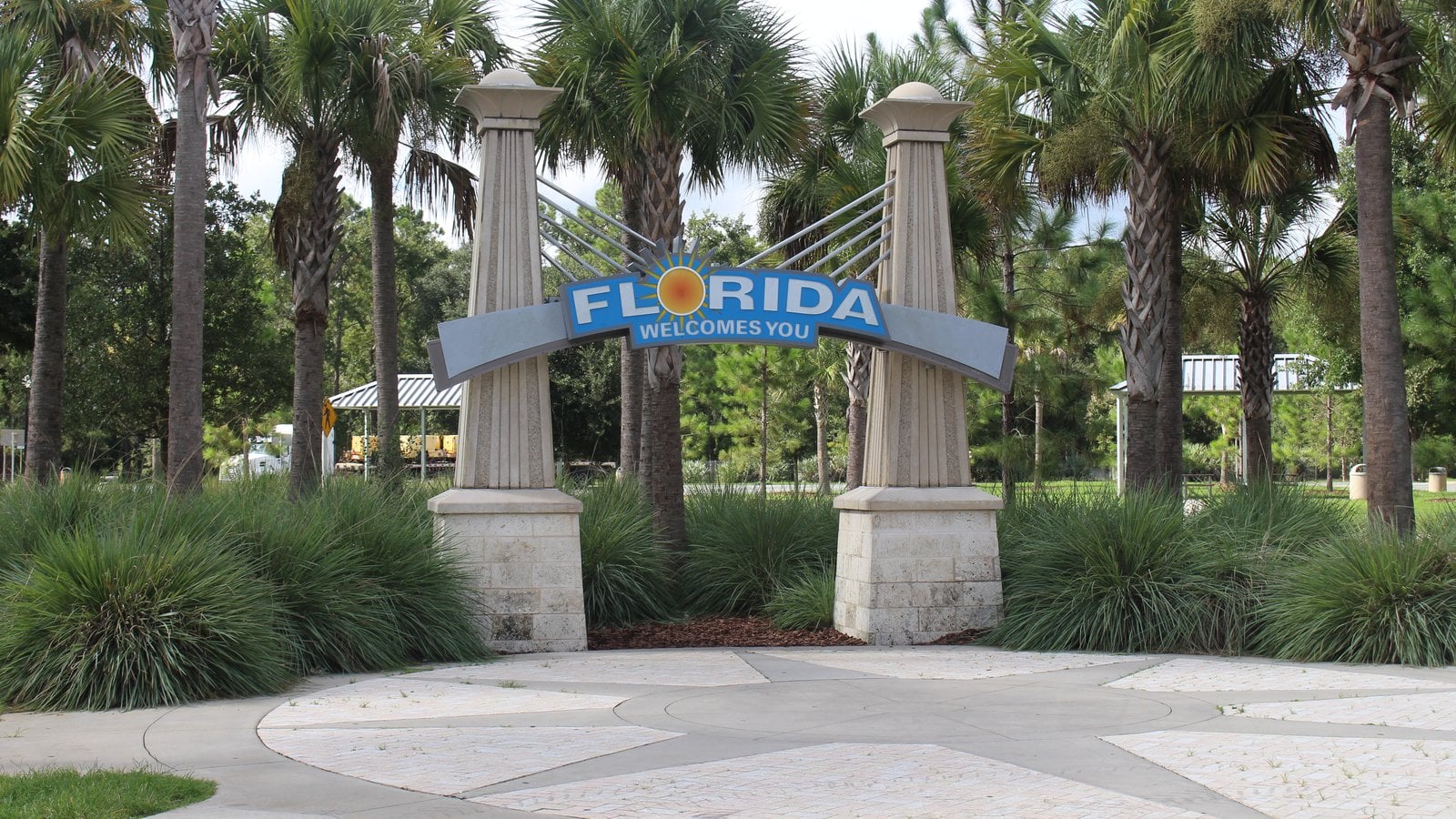
Featured photo: “Florida Welcomes You” sign at the Florida Welcome Center in Jennings, Florida, photographed August 31, 2019 by Michael Rivera, via Wikimedia Commons. Licensed under CC BY-SA 4.0. Cropped and resized.