


The short answer: Before buying a home in Port St. Lucie, FL, confirm three things on the exact address: whether it’s on City water and sewer or a well and septic, whether a City utility lien or special assessment is attached to the parcel, and what the non-ad valorem lines on the tax bill will cost you, not what the seller paid.
By Jeremy Beckham, REALTOR®, SFR | Last updated: November 12, 2026
Port St. Lucie is the city I get the most “just tell me what to watch for” calls about. The City bought its utility in 1994 and has spent the years since running sewer and water out to neighborhoods that started on wells and septic tanks. So two houses on the same street can have completely different setups: one on City sewer for 20 years, one still on a septic tank, one with a sewer connection loan recorded against it. None of that shows up in listing photos. The Port St. Lucie area guide shows the neighborhoods. This post covers what I check on a Port St. Lucie address before my buyers write an offer.
For the Florida rules that apply everywhere in my market (flood disclosure, HOA disclosure, insurance during the inspection period), I keep one home for them in my Boca Raton buyer guide, so I won’t repeat them here.
Key takeaways
- Port St. Lucie runs its own utility, and its low-pressure sewer system is one the City calls the largest of its kind in the nation. Many homes are connected. Some still have a well, a septic tank or both.
- Converting an existing septic system to City sewer costs $9,445 inside a Special Assessment District as of October 1, 2026, or $77.79 a month for 120 months with no interest. Outside those districts the City says costs may vary.
- If a seller financed the connection, the City records a utility capital charge lien on the property. The City’s public lien search doesn’t show it. Call Lien Services at 772-344-4179 for a free verbal balance.
- The 2026-27 tax bill carries a one-time solid waste credit of $364 or $64 from the City’s Waste Pro settlement. The full trash assessment is $482.16, so budget for that, not the seller’s net amount.
- St. Lucie Public Schools uses regional choice zones for elementary and middle school, not neighborhood schools. High school is assigned by ZIP code.
Port St. Lucie buyer checklist at a glance
| Question | Where to check | Why it matters |
|---|---|---|
| Inside City limits? | St. Lucie County Property Appraiser parcel record (taxing district) | City vs. County permits, utility and assessments |
| City water and sewer, or well and septic? | City Utility Systems Connection Support, 772-873-6400 | Conversion cost, monthly bills, the pump panel on the house |
| Any City liens, including utility capital charges? | City Lien Services, 772-344-4179 | A connection loan or code lien has to be paid off or handled at closing |
| Open or expired permits? | City permit search by property | Unfinaled work becomes your problem after closing |
| What will my taxes and assessments be? | Property Appraiser tax estimator plus the parcel’s current tax bill | The estimator leaves out non-ad valorem charges |
| Which schools can my kids apply to? | St. Lucie Public Schools Student Assignment | Zones are regional, and you apply during set windows |
Is my Port St. Lucie address actually inside the City?
Usually, but don’t assume it. “Port St. Lucie” is a mailing city, and a few areas that use it are unincorporated St. Lucie County. River Park is one example. St. Lucie County’s Land Development Code sets a River Park community overlay zone for parts of it. I always check the parcel’s taxing district on the St. Lucie County Property Appraiser site, because the County, not the City, writes the land-use rules on those addresses.
The quick check is the parcel record on the St. Lucie County Property Appraiser’s site, which shows the taxing district. If it’s inside the City, everything below applies. If it’s County, the permit office, utility and assessments are different, and I’ll pull those separately.
Is the home on City water and sewer, or a well and septic?
This is the first thing I ask on any Port St. Lucie resale. The City’s program history says newly built homes have been required to connect to City sewer. Older homes may still be on a septic tank, a private well, or both.
Here’s what the City publishes about its program:
- More than 11,000 residents have switched from septic to sewer since 1999, and the City averages about 350 conversions a year.
- From application to finished install, the City says the process takes 4 to 6 weeks. City crews run the line, abandon the old tank, install the new system and lay new sod.
- Effective October 1, 2026, converting an existing septic system inside a Special Assessment District costs $9,445, or $77.79 a month for 120 months, interest-free with no financial qualification. You also pay a $110 sewer deposit and a $45.50 recording fee with the application.
- The City has closed its conversion grant applications.
Two fine-print items from the City’s online conversion application matter to buyers. An approved application stays open for 12 months, and if the connection isn’t in service by then through no fault of the City, it expires and you reapply at the rates in effect then. And there’s a $300 cancellation fee if you cancel an application.
Florida law also matters here. Under section 381.00655, Florida Statutes, the owner of a working septic system must connect within 365 days after the sewer utility gives written notice that sewer is available. If the septic system needs repair to work properly, the deadline drops to 90 days after notice from the state. So if you’re buying a septic home, ask the seller whether they’ve received an availability notice, and ask the City directly.
What’s that box on the side of the house?
If the home is on City sewer, you’ll usually see a control panel mounted on an exterior wall. Port St. Lucie’s system uses a 200-gallon collection tank and a pump buried in the yard. When the tank fills, the pump sends wastewater into the City line. If something goes wrong, the panel sounds an alarm and shows a red light.
I tell buyers to have the inspector look at the panel and ask the seller whether the alarm has ever gone off. The City’s Connection Support line, 772-873-6400, is staffed 24/7 for alarms. During a power outage, the City asks you to limit water use until power comes back, because the pump runs on electricity.
Does the seller’s sewer connection loan follow the house?
It can. When an owner finances a water or sewer connection over the City’s 10-year interest-free plan, the City’s application says it “creates a lien against the property.” The City’s Lien Services page calls this a utility capital charge lien.
The catch is that the City’s online “Search All Liens” tool covers every City lien except Utility Systems. To get the capital charge balance, call Lien Services at 772-344-4179. It’s free. The same page links a subordination and assumption application, which is the City’s process for a buyer who wants to take over that balance instead of having it paid off at closing.
My approach on every Port St. Lucie purchase:
- Ask the title company to order a City lien search through the Lien Management Portal.
- Call Lien Services for the utility capital charge balance, since the portal search alone may not show it.
- Decide with my buyer, in writing, whether the seller pays it off or the buyer assumes it.
- Check St. Lucie County’s public records too. The City notes its own records may not show every lien.
The City also records liens for code violations, work done without permits, vacant lot mowing and unpaid utility usage. A lien search catches those before they become yours.
What will the extra lines on a Port St. Lucie tax bill cost me?
Plan on about $677 a year in City flat charges on a typical Port St. Lucie home: $195 for stormwater plus $482.16 for trash, before any one-time credit, plus any special assessment or CDD line. Those lines are non-ad valorem assessments, flat City charges that are not based on the home’s value.
| Line on the bill | 2026-27 amount | Billing period | Source |
|---|---|---|---|
| City stormwater fee | $195 per equivalent residential unit (vacant lots are charged a lower rate) | October 1 to September 30 | FY 26/27 Adopted Budget in Brief; Resolution 26-R60 (preliminary rate resolution) |
| City solid waste (trash) | $482.16 per dwelling unit, before any credit | Fiscal year from October 1 | FY 26/27 Adopted Budget in Brief; Resolution 26-R70 |
| City special assessments (water/sewer or developer districts) | Varies by district | November 1 to October 31 | City Special Assessment & Property Tax |
| CDD (Tradition and other planned communities) | Varies by district | Set by the CDD | My Tradition CDD fees guide |
The 2026-27 trash credit
This one is new, and it’s going to confuse people looking at tax bills this winter. In April 2026, the City settled its lawsuit with former hauler Waste Pro for $24 million, and in June the Council voted to return it as tax bill credits. According to the City’s announcement:
- Single-family homes with the same owner since 2022 get a $364 credit.
- Homes with a title change since then, and new homes, get $64.
- Vacant lots don’t get a credit.
So a seller with the same owner since 2022 may have a 2026-27 bill showing $118.16 for trash ($482.16 minus $364). That’s a one-time number. When you budget, use the full $482.16. The City tied this year’s $14.83 increase to its contract with the hauler, so don’t expect it to drop.
City millage and your own estimate
For the year that started October 1, 2026, the City lowered its total millage from 4.9750 to 4.8750, per the City’s September 29, 2026 announcement. That’s only the City’s share. The County, school board and other districts add their own.
The St. Lucie County Property Appraiser’s tax estimator is the tool I use with buyers. Pick “No” if you’re not bringing homestead portability, enter your price, and it estimates the ad valorem side. The Property Appraiser is clear that the estimate excludes non-ad valorem charges, that it uses known millage rates from 2025, and that past taxes aren’t a reliable projection, because a sale resets the assessed value and removes the seller’s exemptions. Add the stormwater, trash and any special assessment or CDD lines from the current bill to get closer to your real number.
Buying new construction vs. resale in Port St. Lucie
The City says more than 60,000 people have moved to Port St. Lucie since 2020, so many of my buyers compare a builder’s spec home against a resale a few miles away. A few things are specific to new construction here.
The first tax bill can be low. Under section 192.042, Florida Statutes, property is valued on January 1, and improvements that aren’t substantially completed on that date get no value. A house finished in March may be taxed mostly as land for that first year. The next bill includes the house. Plan your escrow for the second year, not the first.
Utility fees are set up differently. The City’s New Customers page lists separate fee worksheets for new construction and for well and septic conversions. If you’re building on a lot, confirm with Connection Support what’s included in the builder’s price and what you’ll pay.
Permits still matter on resales that look new. A five-year-old house can have an open pool or screen enclosure permit. I run every address through the City’s permit search before the inspection period ends.
Owner-builders have to show up in person. If you plan to pull your own permits for a project after closing, the City’s Building Online Services page says homeowner builder permits must be applied for in person, and the work has to be for your own use, not for sale or lease.
Inside planned communities, the developer district and CDD rules change by neighborhood. My Tradition vs. St. Lucie West comparison and the St. Lucie West guide go deeper on those two areas, and the PGA Village Verano guide and Tesoro Club guide cover two more communities buyers ask me about.
How do the Green, Blue and Red school zones work in Port St. Lucie?
This trips up buyers moving from almost anywhere else. St. Lucie Public Schools doesn’t assign elementary and middle schools by neighborhood. The district uses three regional zones for those grades, divided by Midway Road and Florida’s Turnpike, and you apply to schools inside your zone rather than being assigned to the closest campus:
- Green Zone: north of Midway Road
- Blue Zone: south of Midway Road and east of the Turnpike
- Red Zone: south of Midway Road and west of the Turnpike
Each zone has several elementary and middle schools, and you rank your choices. The district gives preference to siblings and to families living within two miles of a school. Getting a seat is a two-step process: apply for a school, then register at the school once assigned. The district’s FAQ says families should hear back within 6 to 8 weeks after open enrollment, and kids who don’t get their first or second choice go on the wait list for their first pick.
High school is different. Students are assigned to their zone high school by ZIP code, and in some ZIPs by a road or canal line. The dates currently posted on the Student Assignment page are for the 2026 cycle: high school enrollment January 1 to 31, K-8 open enrollment March 1 to 31, and applications reopen May 1. If you’re buying now for the next school year, check that page for 2027 dates.
Here’s what I tell buyers: don’t pick a house because it’s “near” a school. Look up the address on the district’s interactive map, check which zone and transportation area it’s in, and call Student Assignment at 772-429-3930 with questions. The district also notes that bus service isn’t guaranteed if you choose a school outside your ZIP code’s transportation area.
Flood zones and insurance
Port St. Lucie has its own flood-insurance details, including a Community Rating System discount. I covered those in my Port St. Lucie flood zone checklist, so I won’t repeat it here. Read it before your inspection period starts.
Frequently asked questions
Do I have to hook up to City sewer if I buy a Port St. Lucie home on septic?
Not right away if the septic system works and you haven’t been notified that sewer is available. Florida law requires connection within 365 days after the utility’s written availability notice, or within 90 days after a state notice if the system needs repair. Ask the seller and the City whether a notice has gone out.
How much does it cost to switch a Port St. Lucie home from septic to City sewer?
Effective October 1, 2026, the City lists $9,445 for a home inside a Special Assessment District, or $77.79 a month for 120 months with no interest. Add a $110 deposit and a $45.50 recording fee. Outside those districts the City says the cost may vary, so get a quote for the exact address.
Can I take over the seller’s sewer connection loan?
Possibly. A financed connection becomes a utility capital charge lien, and the City’s Lien Services page links a subordination and assumption application. Call Lien Services at 772-344-4179 for the balance and decide in the contract whether the seller pays it off or you assume it.
Why is the trash charge on my Port St. Lucie tax bill higher than the seller’s?
The 2026-27 bills carry a one-time Waste Pro settlement credit: $364 for homes with the same owner since 2022, $64 for newer owners and new homes. The full assessment is $482.16 per dwelling unit. A long-time seller’s bill may show $118.16 ($482.16 minus $364), but you should budget for the full amount.
What is the stormwater fee on a Port St. Lucie tax bill?
It’s a flat City charge that pays for drainage: pipes, ponds, pump stations and canals. For the year that began October 1, 2026, the City’s adopted budget sets it at $195 per equivalent residential unit for a typical home. Vacant lots are charged a lower rate. It’s billed on your property tax bill and isn’t based on value.
Why are the first-year taxes on a new Port St. Lucie home so low?
Florida values property as of January 1, and a house that isn’t substantially complete on that date gets no value that year. Your first bill may be mostly the land. The second bill includes the finished home, so plan for a jump in your escrow.
When do I apply for a Port St. Lucie school after I buy?
The dates now posted are for the 2026 cycle: high school January 1 to 31, K-8 open enrollment March 1 to 31, and applications reopen May 1. Check the Student Assignment page for 2027 dates. New students can apply once they have St. Lucie County proof of address. Call Student Assignment at 772-429-3930 if you close after a window.
Thinking about buying in Port St. Lucie?
I’ll check the utility setup, call Lien Services, run the permit search and build your tax estimate with the real assessment lines before your inspection clock runs out. Call or text me at 772.475.5371.
Browsing homes in Port St. Lucie? See my Port St. Lucie homes for sale page.
About the author
Jeremy Beckham, REALTOR®/SFR with NextHome Treasure Coast, has spent 17 years helping buyers and sellers from Fort Pierce and Port St. Lucie through Martin County and south to Boca Raton. His office is at 414 S Colorado Ave in Stuart. See how I source my numbers, the utilities by county and city guide, or my buyer services.
This post is general information, not legal, tax or insurance advice. Fees, assessments, credits and school zones change. Confirm details with the City of Port St. Lucie, the St. Lucie County Property Appraiser and Tax Collector, St. Lucie Public Schools and a Florida real estate attorney.
Sources
- City of Port St. Lucie, Septic to Sewer Conversion Program (cost effective October 1, 2026; process; sewer system description; grants closed)
- City of Port St. Lucie, Utility Systems New Customers (deposits, new construction and conversion fee worksheets)
- City of Port St. Lucie, Utility Systems online conversion application (Sec. 61.04(n) 12-month expiration, $300 cancellation fee, loan lien)
- City of Port St. Lucie, Lien Services (utility capital charge liens, verbal balances, lien types)
- City of Port St. Lucie, Special Assessment & Property Tax (billing periods, district maps)
- City of Port St. Lucie, FY 26/27 Adopted Budget in Brief (stormwater $195 residential; solid waste $482.16; one-time $364 or $64 credit), listed on the Annual Budget page
- City of Port St. Lucie, Resolution 26-R60 (preliminary stormwater rate resolution recommending $195 per ERU, passed July 27, 2026) and Resolution 26-R70 (solid waste $482.16; Legistar status still listed as Agenda Ready)
- City of Port St. Lucie, Waste Pro settlement allocation (June 16, 2026) and FY 2026-27 millage (September 29, 2026)
- City of Port St. Lucie, Building Online Services and permit search by property
- St. Lucie County Property Appraiser, Tax Estimator (excludes non-ad valorem charges; uses known millage rates from 2025)
- St. Lucie County, Land Development Code, River Park community overlay zone (4.02.00)
- St. Lucie Public Schools, Student Assignment (2026 cycle dates), interactive map, elementary and middle school zones, high school boundaries and open enrollment FAQ (new students may apply once they have St. Lucie County proof of address)
- Florida Statutes (2026), 192.042 and 381.00655
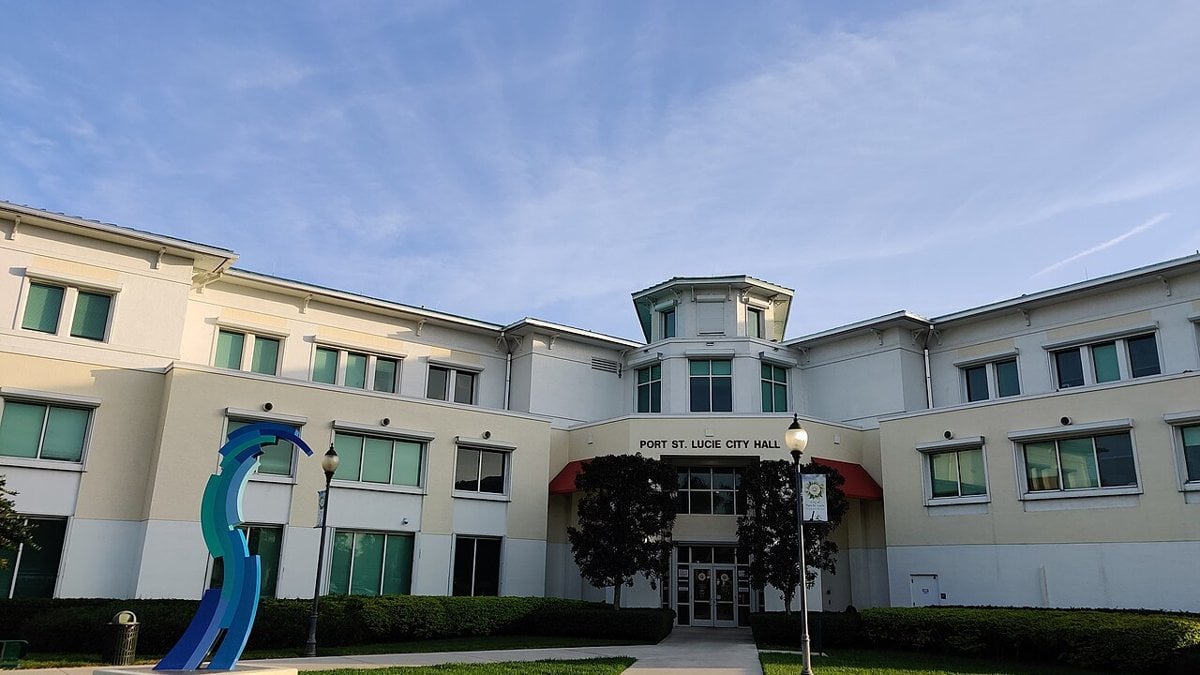
Featured photo: “Port St. Lucie City Hall” by Birbie28 on Wikimedia Commons, licensed CC BY-SA 4.0. Cropped from the original.